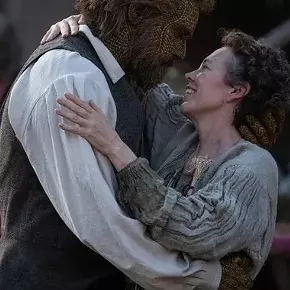
The Woodstock Film Festival hosts a special screening of The Testament of Ann Lee, which opened this years festival in October. With The Testament, writer-director Mona Fastvold continues her quiet project of reanimating the historical interior lives that rarely get marquee treatment. After The World to Come and her recent co-writing turn on The Brutalist, Fastvold turns her lens on Ann Lee, the 18th-century English mystic who founded the Shakers and preached a radical gospel of gender equality, communal living, and ecstatic devotion—ideas that both electrified her followers and scandalized her contemporaries. Amanda Seyfried inhabits Lee with an urgency that vaults the performance beyond hagiography; she’s flinty, visionary, exhausted, and incandescent by turns, guiding the film through the contradictions of a woman trying to build a utopia in a world that isn’t much interested in one.
Fastvold stages the Shaker faith not as a quaint folk artifact but as a kinetic, corporeal practice. More than a dozen traditional hymns are reworked into feverish performance sequences choreographed by Celia Rowlson-Hall (Vox Lux), translating spiritual rapture into physical movement. Daniel Blumberg, fresh off his Oscar win for The Brutalist, contributes original songs and a score that braids austerity with emotional voltage.
The film ultimately works on two planes: as a rigorously researched portrait of a sect that tried to remake society from the ground up, and as a study of the personal cost of visionary leadership. It’s a reminder that utopian dreams tend to be both luminous and bruising—and that Ann Lee, long flattened by history, still has something urgent to say.